
Every rancher who tries virtual fencing goes through a learning curve. For Chris Solecki, that curve landed in one of the toughest grazing years in recent memory. We caught up with Chris after the season to talk about what worked, what didn’t, and what he’d tell another producer thinking about putting neckbands on their herd.
Why Chris chose virtual fencing
Chris runs a fairly intensive grazing operation in Northern British Columbia, with his cattle grazing large remote areas with heavy timber cover, which is exactly why virtual fencing appealed to him. On rangeland, building and maintaining physical fence isn’t practical, so he needed a way to contain his cattle without stringing wire across every pasture.
Then the weather made the case even stronger. In 2025, their area had very little rain and poor grass growth, so forage supply ran out about two weeks earlier than normal. In a year like that, controlling where cattle graze stops being a nice-to-have; it’s critical to grass management and protecting the range so it can recover for next season.
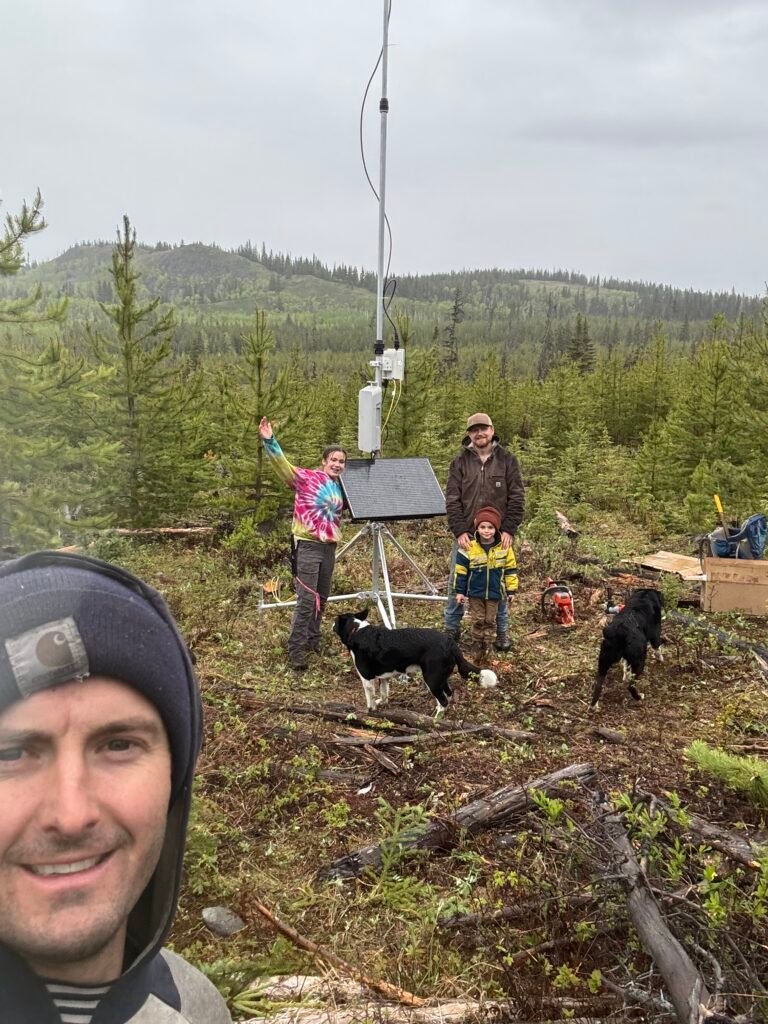
Chris contacted us in 2025 to find out if eShepherd virtual fencing was a good fit for his ranch, given he has such a large range tenure area. We did an assessment and found that he’d need to use base stations to provide connectivity through the large area.
How Chris paid for it: the On-Farm Climate Action Fund
Virtual fencing is a real investment, and Chris didn’t cover it all out of pocket. He funded his eShepherd setup through the On-Farm Climate Action Fund (OFCAF), rotational grazing stream. In BC, that stream is delivered by the Canadian Forage and Grassland Association (CFGA) together with the BC Forage Council.
The program is built for producers who want to graze more intentionally, which made it a natural fit for Chris’s operation. Eligible costs include grazing plans, fencing (virtual fencing among them), water systems and pasture improvements.
How the funding works:
What the first season taught him
2026 was the first season of using eShepherd virtual fencing on his ranch, and this first year was a learning experience. Much of it came down to figuring out how to apply the tool in a way that fit his country and his cattle.
Some of the biggest lessons came from working in a challenging rangeland scenario:
Getting set up
Chris activated the neckbands up at the range before the cattle arrived, then brought around 200 cows up. The area has no cell service, so the system ran on base stations. He started with six and may add more next year. Only one spot gave him connectivity trouble.
His advice for the start of the season is to plan it out and make the first training session count. Introducing the cattle to the virtual boundary alongside a physical fence gives them a reference point while they learn what the audio cue means. Early on, most of his boundaries were perimeter fences.
Neckband retention and animal health
This is the question every producer asks, so Chris was candid about it.
Chris’s fitting tip: use the four-finger rule. You should be able to slide four fingers under the band. Too loose and it rubs or falls off; too tight and you’ll see problems.
What the results looked like
Even with a short forage year, the calves came off looking better than usual, noticeably ahead and well fed. The cows, on the other hand, came in looking thinner, which makes sense given the dry conditions and the pressure on available forage.
The herd’s reproductive numbers were strong. Yearlings had a good preg check, and all the cows got good bull exposure. That gives Chris more bred heifers to sell or keep, and better information for making cull decisions.
The plan from here: weigh and vaccinate, then background the calves on grass for another year.
Chris’s takeaways for other producers
Thinking about virtual fencing for your operation?
Okanagan Ranch and Fence Supplies can help you plan your setup, from base station coverage to herd training. Get in touch to talk through your range.