

eShepherd in Winter: Does It Actually Work for Bale Grazing?
Written by Sarah Fennell, P.Ag. | Okanagan Ranch and Fence Supply
When most people think about virtual fencing, they picture summer grazing — rotating cattle through lush paddocks, managing riparian areas, saving hours on fence moves during the growing season. What fewer people realize is that some of the most compelling use cases for eShepherd happen in winter, when the ground is frozen, the days are short, and the last thing you want to do is drive out to move a fence in -30°C weather.
Lindsay Jamieson at Bunny Coulee Farm near Calgary has been running eShepherd year-round, including through the bale grazing season. His experience answers a question we hear constantly from Canadian ranchers considering the system: does it actually hold up in a Canadian winter?
The short answer is yes — with a few things worth knowing upfront.
What is Bale Grazing?
Bale grazing is a winter feeding method where you distribute round bales across a field before the ground freezes, then rotate cattle through them in a controlled sequence rather than feeding from a central location or feeding area. Instead of hauling bales to cattle all winter, you let the cattle come to the feed — one bale or small group of bales at a time, on your schedule.
The agronomic logic is straightforward. When cattle are restricted to a small area around each bale before moving to the next, their manure, urine, and hay waste get distributed evenly across the field rather than concentrated in one spot. Come spring, that organic matter feeds soil biology across the entire area. Producers who have been bale grazing for several years typically see meaningful improvements in soil health, reduced need for fertilizer, and better spring forage growth on their bale grazing fields.
Done with physical temporary fencing, bale grazing is effective but labour-intensive. You are moving the fence in whatever weather winter decides to deliver, every few days, all season. That labour cost is the main reason more producers do not do it as precisely as they know they should.
That is where eShepherd changes the picture.
What is eShepherd?
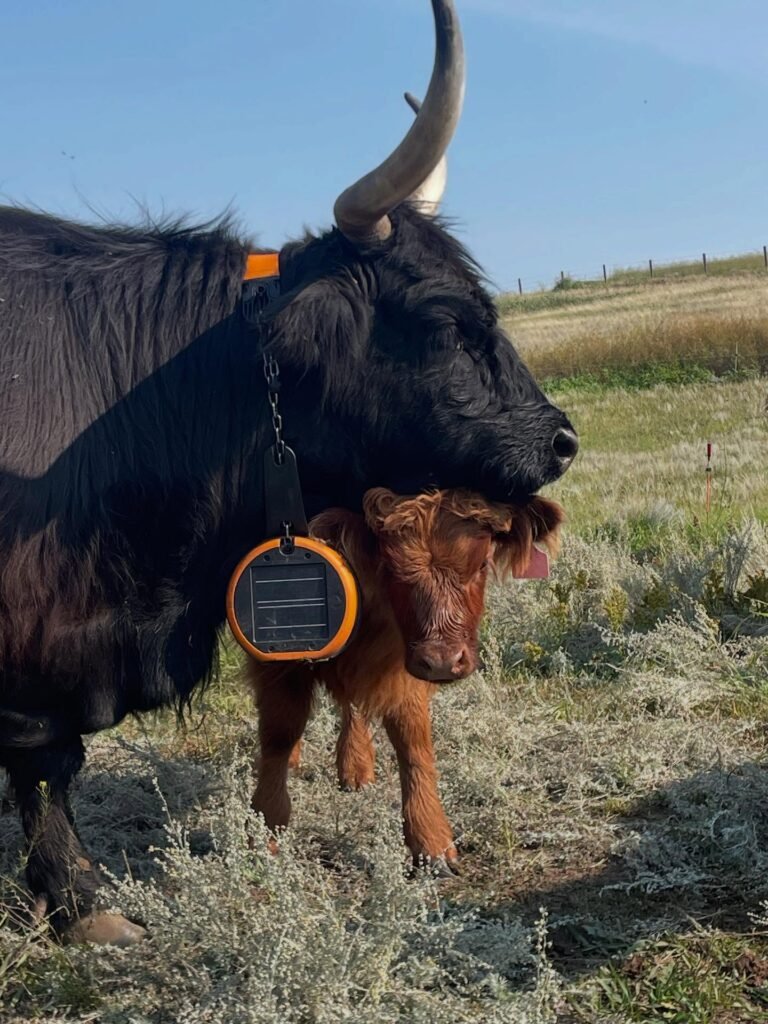
eShepherd is a virtual fencing system for cattle that replaces physical wire and electric fence with GPS-enabled neckbands and a smartphone app. Each collar delivers a mild audio and electrical cue to guide cattle away from virtual boundaries you set on a map — no posts, no wire, no physical infrastructure required. Boundaries and gates can be opened, closed, or redrawn from your phone in minutes, from anywhere.
How Bale Grazing with eShepherd Actually Works
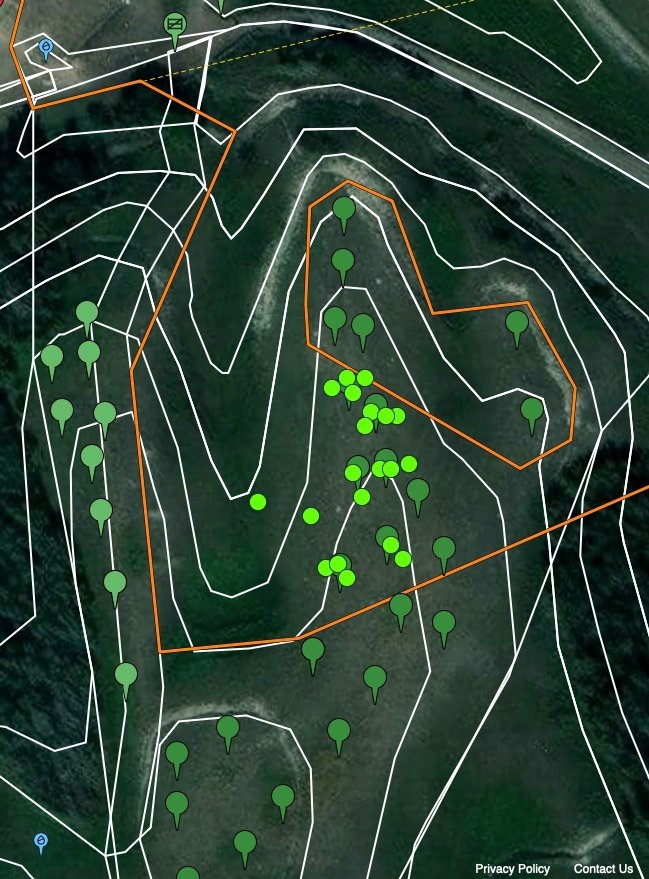
The concept is straightforward, and that’s part of what makes it so useful. Last winter, Lindsay put out 38 bales at a time — distributed across the field in the sequence he wanted cattle to graze through — then numbered each one in the eShepherd system. Rather than physically moving a fence each time it’s time to rotate to the next bale, he simply opens up the next paddock in app, giving the herd access to the next bale on his schedule.
[I make use of the Exclusion Zone feature in the eShepherd web app. I create a perimeter Inclusion Zone around the entire bale grazing area which also includes the path back to water. Inside this, the Exclusion Zone surrounds all the bales I do not want accessed, and I can adjust the access to new bales by shrinking the Exclusion Zone to allow it.]
~Lindsey
No driving out. No frozen fingers on fence posts. No equipment. Just a few taps on a phone.
For anyone who has spent time moving temporary electric fence in February, the appeal is obvious. But it goes beyond comfort. Bale grazing done well requires precision — you don’t want the cattle to run out of feed, or wasting hay, especially with hay prices these days. With a physical fence, that precision costs labour time every single time you move it. With eShepherd, the precision is the same whether you’re moving every two days or every five, because the labour is essentially zero.
Lindsay has described the system saving him about 2 hours per day doing bale grazing In winter, when daylight is already limited and temperatures are punishing, that kind of time recovery isn’t just convenient — it changes what’s operationally possible.
Does the Collar Actually Work at -30°C?
This is the first question most ranchers ask, and it’s a fair one. Electronics and extreme cold don’t always mix well.
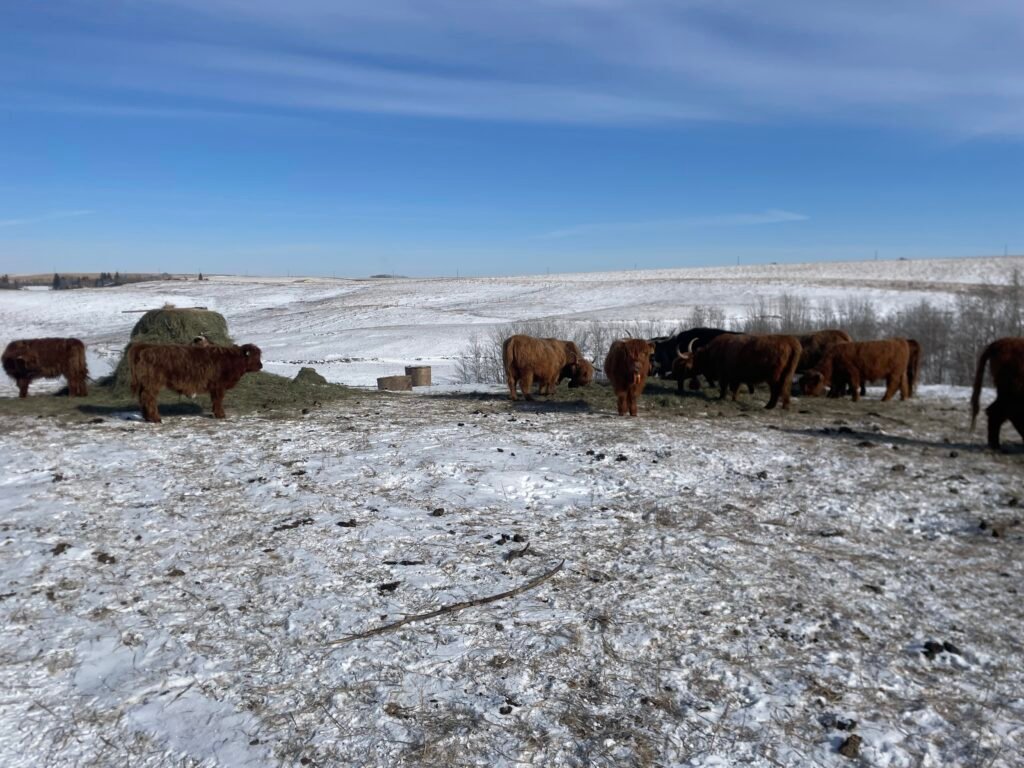
The eShepherd neckbands have been working well in cold Canadian conditions, and real-world use at Bunny Coulee Farm confirms they hold up at -30°C. The cattle wear the collars through the full Alberta winter without collar failure being a meaningful concern.
That said, there is one legitimate cold-weather limitation worth knowing about: solar charging in extended overcast conditions.
The collars are solar-powered, which works extremely well for most of the year. But in deep winter, when you get prolonged foggy or heavily overcast stretches — the kind of grey weeks that Alberta and parts of BC can serve up in January — charge accumulation slows down. If overcast conditions persist long enough, collar battery levels can become a management consideration.
This isn’t a system failure, and it doesn’t happen constantly. But it’s real, and we’d rather tell you about it than have you discover it mid-winter. The practical mitigation is monitoring battery levels through the app, which gives you visibility before it becomes a problem. In most winters, this is a minor factor. In an unusually dark stretch, it requires attention.
[Most of the time, even when a battery is low overnight, herd behaviour still governs where the animals go. The collars that lose battery most frequently are on the animals that are testing the boundaries most frequently. If perhaps one of them discovers the boundary is down, she may go ahead to a bale of her choice but will eventually be back in the herd within hours. With some daylight, the collar is charged and she is unable to cross the boundary as expected. Just as the calves are getting ahead on the bales, so do sometimes an animal with low battery but it never lasts very long]
~Lindsey
Does the Subscription Cost Keep Running in Winter?
One of the more underappreciated features of the eShepherd system is the subscription flexibility, especially for ranchers who don’t graze year-round.
If you’re bale grazing in winter using the eShepherd collars, you’d need the subscriptions to be active. But if you keep your cattle in corrals and feed silage or hay during the winter and put your collars on the shelf, you can pause the subscription. You’re not paying monthly fees on hardware that’s sitting unused. When spring grazing resumes and the collars go back on, the subscription restarts.
For a BC and Alberta ranching operation running 5–7 months of active grazing, this means your real annual subscription cost reflects actual use — not a 12-month flat fee for equipment that’s idle half the year. At $2.00–$2.50 per collar per month, that savings option makes a difference.
One Honest Limitation: Elk Pressure
Bale grazing with eShepherd works well when the main management challenge is your own cattle. It works less well if you’re dealing with serious elk pressure.
The virtual fence contains your herd effectively — that’s well established. What it doesn’t do is keep elk out. If you’re in an area with significant elk populations and you’ve laid out a field of bales in advance, you’re potentially making that feed accessible to wildlife as well. The collars won’t deter elk, and a field of bales sitting in an elk travel corridor is a risk worth thinking through before committing to this approach.
For operations where elk are a real factor, this doesn’t mean bale grazing with eShepherd is off the table — but it does mean the layout strategy and timing matter more. It’s worth a conversation about your specific property before you design the system around it.
One More Limitation: Snow Cover and Frozen Bale Residue
There’s a second winter scenario worth knowing about, and it’s specific to how bale grazing unfolds.
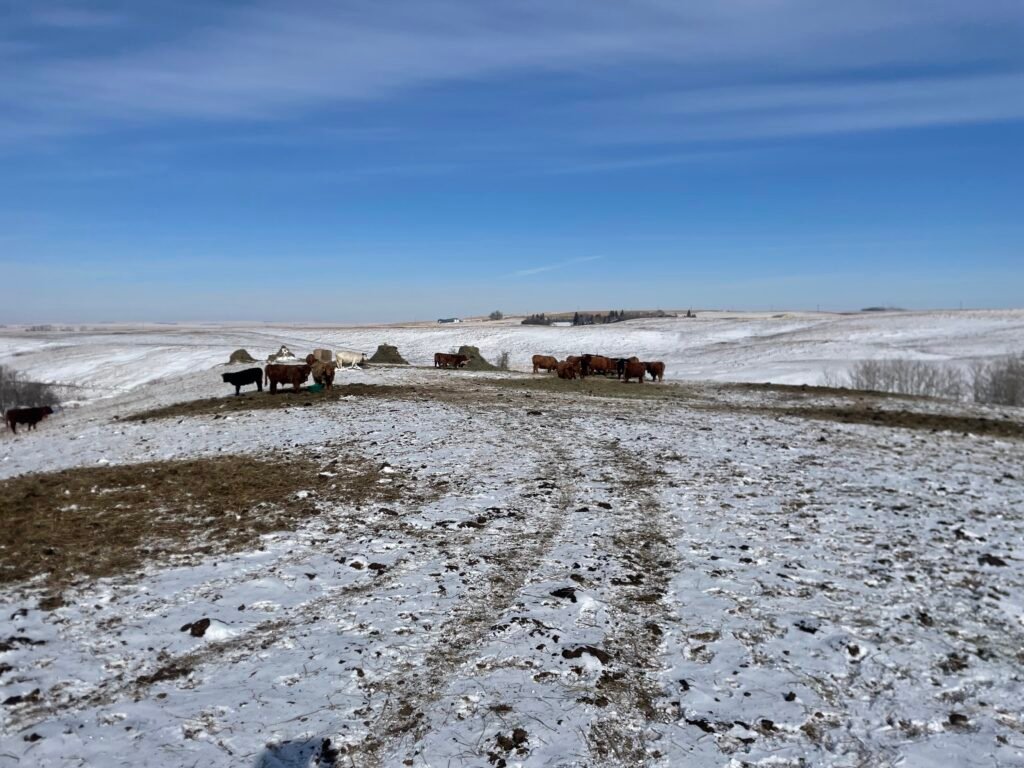
When cattle have grazed a bale down to roughly 20% remaining and then a significant snowfall hits — say 5–6 inches — followed by a hard freeze, that residual hay can become locked under a crust of ice and compacted snow. At that point the cattle can’t get to it, and what was left of that bale is effectively lost.
This isn’t unique to eShepherd — it’s a general bale grazing challenge in climates with freeze-thaw cycles. But it’s worth factoring into how you time your rotations. The eShepherd app gives you the flexibility to open the next virtual paddock early if conditions warrant — which is actually an advantage over physical fencing, where an early move means a fence move in whatever weather you’re dealing with.
Is Virtual Fencing the Right Fit for Your Winter Operation?
Bale grazing with eShepherd tends to be a strong fit when:
- Labour in winter is limited, costly, or simply miserable to deploy in extreme cold
- You want the nutritional and soil health benefits of disciplined bale rotation without the daily fence-moving overhead
- Your operation is in an area with reasonable solar charging conditions for most of the winter
- Elk pressure on your specific property is manageable or low
It’s worth a closer look and honest conversation if:
- Your winters regularly feature extended weeks of heavy overcast with minimal sun
- Your property has significant elk pressure in areas where you’d be laying out bales
- You experience frequent hard freeze-thaw cycles that could lock down bale residue before cattle finish it
The Bottom Line
Lindsay Jamieson’s experience at Bunny Coulee Farm is about as real-world a test of winter eShepherd performance as you’ll find. The system runs at -30°C. The bale grazing application is genuinely practical — laying out your winter feed in advance and rotating access from your phone is not a marginal improvement over moving fence by hand in a Canadian winter. It’s a substantial one.
The solar charging limitation in prolonged overcast conditions is real and worth managing for. The elk caveat is worth thinking through for properties where it applies. Neither of these is a reason to dismiss the system — they’re just the honest version of what we tell every rancher who asks.
If you want to talk through whether this setup makes sense for your specific operation, winter conditions, and property, we’re happy to have that conversation.
Request a free operational assessment or call us at (250) 309-4955.
Sarah Fennell is an agrologist with a background in range management and a lifelong connection to agriculture in the BC interior. Okanagan Ranch and Fence Supply is the only authorized Gallagher eShepherd dealer with a home base and warehouse in British Columbia.