
“What does eShepherd virtual fencing cost?” is the first question almost every rancher asks us. It’s a fair question, and it usually gets a frustrating answer: call for a quote.
We get why dealers say that. Herd size, terrain and cell coverage really do change the number. But you shouldn’t have to get on the phone just to find out whether virtual fencing is even in the ballpark for your place.
So here are our actual eShepherd prices, in Canadian dollars, with the math worked out for real herd sizes. We’ve been fencing BC and Alberta ranches since 1985, and we’d rather you walk in knowing the numbers.
eShepherd virtual fencing cost: the short answer
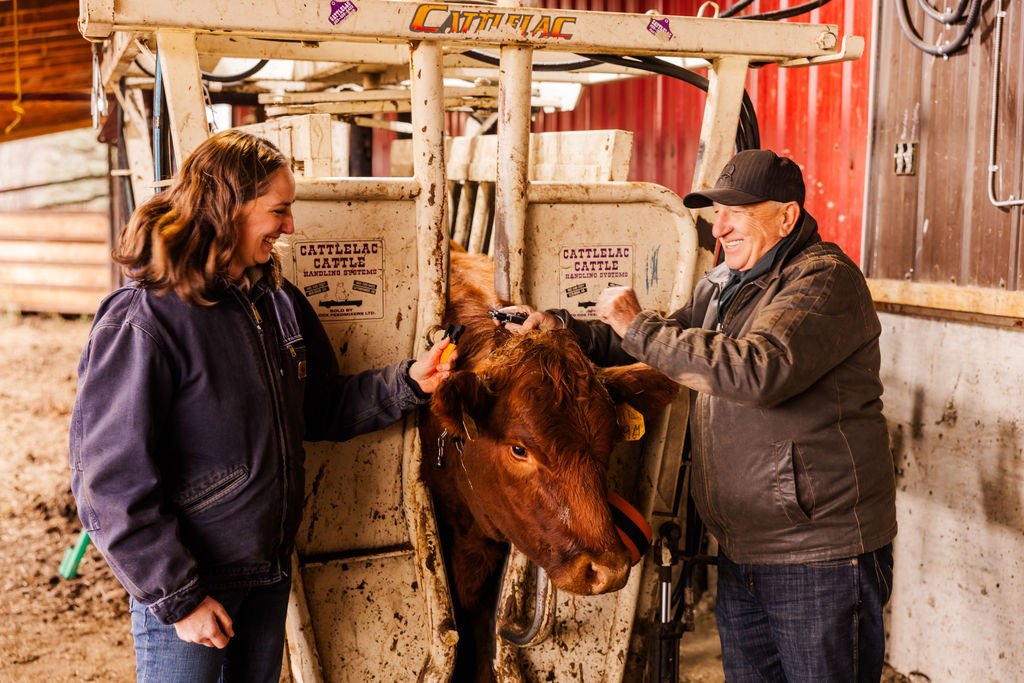
eShepherd neckbands cost $350 to $415 CAD each, depending on how many you order, plus a small monthly charge only while they’re turned on. A 40-head herd on cellular coverage runs about $16,600 up front. If you’re eligible for OFCAF funding, it can cover up to 85% of that, dropping your share to about $2,490.
Prices current as of November 2026. Taxes and shipping extra.
What you’re paying for
The neckbands are most of the bill; everything else is small or optional.
| Item | Price (CAD) | When you pay it | Notes |
|---|---|---|---|
| Neckband | $415 each (20–59) $350 each (60+) |
Once, up front | Minimum order 20. Same price for cellular or LoRa. |
| Connectivity, cellular | $2.50 per collar per month | Only months the collar is turned on | Uses existing cell networks. No base station needed. |
| Connectivity, LoRa | $2.00 per collar per month | Only months the collar is turned on | For pastures with no usable cell signal. |
| Base station | $6,000 first $5,000 each additional |
Once, LoRa only | The number of base stations you need depends on your land. We offer a free assessment: contact us. |
| Neckband key | $50 | Once | Tool for fitting and removing bands. |
| Long neckband chains | $25 per pair | As needed | For bigger-necked cattle and bulls. |
| Spare top straps (3-pack) | $90 | As needed | |
| Spare locking clips (20-pack) | $15 | As needed | |
| Setup and training support | Free | Once | Lee walks you through mapping and fitting, and we’re here whenever you need help after that. |
Three things that shape your quote
You buy the hardware; you don’t lease it. Gallagher’s model is ownership: if the neckbands aren’t on cattle, you aren’t paying for them.
Cellular or base station? Check your coverage before you budget. If you can send a text from about 70% of your grazing area, cellular neckbands skip the base station entirely, which is the single biggest saving in most quotes. On remote Crown range with no signal, a base station is the cost of entry. Many BC places end up running both on one account. If you’re not sure what system you need, contact us for a chat.
Herd size and type. The minimum order is 20 neckbands, and Gallagher recommends at least 20 head because cattle learn the boundary as a group. At 60 or more, the price per neckband drops from $415 to $350.
What it costs for your herd
Over an 8-year life, eShepherd works out to roughly $59 to $67 per head per year before funding and $20 to $23 per head per year after 85% funding. These examples assume a 6-month grazing season with collars turned off over winter, an 8-year life, and 85% funding on hardware.
| Herd | Coverage | Up front | Connectivity per season |
Your cost after funding |
Per head/yr unfunded |
Per head/yr funded |
|---|---|---|---|---|---|---|
| 20 head | Cellular | $8,300 | $300 | $1,245 | $67 | $23 |
| 40 head | Cellular | $16,600 | $600 | $2,490 | $67 | $23 |
| 60 head | Cellular | $21,000 | $900 | $3,150 | $59 | $22 |
| 100 head | LoRa, 1 base station | $41,000 | $1,200 | $6,150 | $63 | $20 |
What’s included: funding is applied to hardware only, so connectivity is shown as an ongoing cost you pay yourself.
Running 51 to 59 head? Order 60. At $415 each, 51 neckbands cost $21,165, which is more than 60 at $350 ($21,000). Above 50 head, the extra neckbands are effectively free spares.
Running year-round? Double the connectivity column.
How funding changes the number
The On-Farm Climate Action Fund (OFCAF) is a federal program available across Canada, delivered by a different organization in each region. Virtual fencing is eligible under its rotational grazing stream in BC, Alberta, Saskatchewan, Quebec and Ontario, with up to 85% of eligible costs reimbursed depending on the province. You pay the full cost up front and claim it back.
Four things to know before you apply
- Start with a grazing plan. Most programs require a rotational grazing plan with your application, usually signed off by a professional agrologist or certified crop advisor. Grazing mentors can help you build one; in BC, see the BC Forage Council’s list of grazing mentors.
- You pay first. Programs reimburse after you’ve paid and submitted proof of payment.
- The funding is taxable. OFCAF payments count as farm business income.
- Dates matter. In Alberta, 2026–27 invoices and proof of payment must fall between April 1 and November 30, 2026. If you missed this round, plan your 2027 project now so the quote is ready when the next intake opens.
We’ll write your quote so it’s funding-ready. Lee prepares quotes with the item-by-item detail the applications ask for, such as quantities, unit costs and base station details.
Program rules change each intake. Confirm current details with RDAR, CFGA, IAF or the BC Forage Council before you buy.
How it compares with building fence
In many cases, building fences can cost more than a complete eShepherd virtual fencing system. After the 2017 and 2018 wildfires, the BC Cattlemen’s Association put replacement fence at around $25,000 per kilometre. A 60-head cellular eShepherd setup is $21,000.
Compare eShepherd against interior cross-fencing, not your perimeter. Virtual fencing does not replace a boundary fence; you still need one for containment, liability and your neighbours.
The bigger difference is that a built fence stays where you built it. With eShepherd, you draw paddocks from your phone or computer, so the question isn’t cost per kilometre. It’s how many kilometres you never have to build, check or repair because of elk damage, snow and wildfire.
Virtual fencing brings its own upkeep: neckbands to fit and check, a monthly charge, and a reliance on coverage. Whether that trade-off pays depends on your operation.
When it pays, and when it doesn’t
eShepherd pays best for producers who practise rotational grazing, move cattle often, and have large areas that are hard or expensive to fence and maintain. It may not pay for small herds or pastures that are already fenced the way you want them.
It usually pays if:
- You run 20 or more head.
- You have a sound perimeter fence (or natural barriers on range).
- You move cattle weekly or more, or graze ground where wire or electric fencing is impractical: steep slopes, riparian areas, burnt range.
- You qualify for OFCAF funding.
It usually doesn’t pay if:
- Your herd is under 20 head.
- You run sheep or goats (the neckbands don’t work on these smaller animals).
- Your pastures are already cross-fenced and nothing moves.
In those cases, a solar electric fence system is cheaper and simpler, and we’ll tell you so.
What it looks like on real BC ranches:
- Four X Ranch near Armstrong used eShepherd to graze burnt country before the fences went back up.
- Chris Solecki in Northern BC took on virtual fencing in one of the toughest grazing years in recent memory and shares what the learning curve was really like.
Is it worth it beyond the dollars?
Return on investment isn’t only about cost per head. The bigger questions are whether it makes your days easier, saves you time, and gives you information you didn’t have before.
Time. Moving a paddock boundary becomes a few minutes on your phone instead of a day with a reel and a quad. You can see where the herd is before you head out, so trips to check cattle or round up in the fall become tremendously easier.
Information. Every neckband reports where that animal is and how it’s moving. Over a season, that builds a picture you can’t get from the truck window: where cattle actually graze, which areas get hammered and which get missed, and which animals like to wander.
Using the data. The information only pays off if someone looks at it, so make checking the app part of your daily routine. Pay attention to where cattle are congregating and how the grass is responding, and make informed decisions about how to move your livestock.
Making it work on your operation
Every operation has its own way of doing things, often built over generations, and that experience matters. Even a good tool won’t stick if it’s dropped on people without a say in how it’s used. A few things that help:
- See it first. We can show you how it works with a demo, or point you to a field day, so you can watch cattle on eShepherd before you commit. You can also see it in action on our YouTube channel.
- Start small. Let your cattle get used to the system with simple boundaries first. Complex rotational moves can come with time, once you and the herd are comfortable. There’s no need to overwhelm yourself or your livestock.
- Bring everyone in. Include whoever moves the cattle day to day, not just whoever signs the cheque. Their questions make the setup better.
- Expect a learning curve. Mistakes happen in the first few weeks, for the cattle and for the people. That’s normal, and we’re here to help you through it.
- Share what you learn. Producers learn most from each other. Our customer stories, like Chris Solecki’s interview, are an honest look at what worked and what didn’t.
Common questions
How much does one eShepherd collar cost in Canada?
$415 CAD each on orders of 20 to 59, or $350 each on orders of 60 or more, plus $2.50 a month (cellular) or $2.00 a month (LoRa) while the collar is turned on.
Is there a minimum order?
Yes, 20 neckbands. Gallagher recommends at least 20 animals for training because cattle learn the boundary as a group.
Do I need a base station?
Only if you choose LoRa neckbands for pasture with no usable cell signal. The first base station is $6,000 and each additional one is $5,000. Cellular neckbands need no base station. We’ll help you figure out what system you need.
How much cell coverage do I need for cellular neckbands?
Less than you might think. You don’t need full coverage everywhere, just across about 70% of the area, and the signal only needs to be good enough to send a text message. Not sure about your place? Contact us and we’ll walk you through it.
Do I pay the subscription all year?
No. The monthly charge applies only while a neckband is turned on. Turn them off over winter and you pay nothing for those months.
Can government funding cover virtual fencing?
Yes. OFCAF covers virtual fencing in BC, Alberta, Saskatchewan, Quebec and Ontario, reimbursing up to 85% of eligible costs depending on the province. You pay up front and claim it back.
Do I still need a perimeter fence?
Yes. eShepherd replaces interior cross-fencing, not your boundary fence.
How long do the neckbands last?
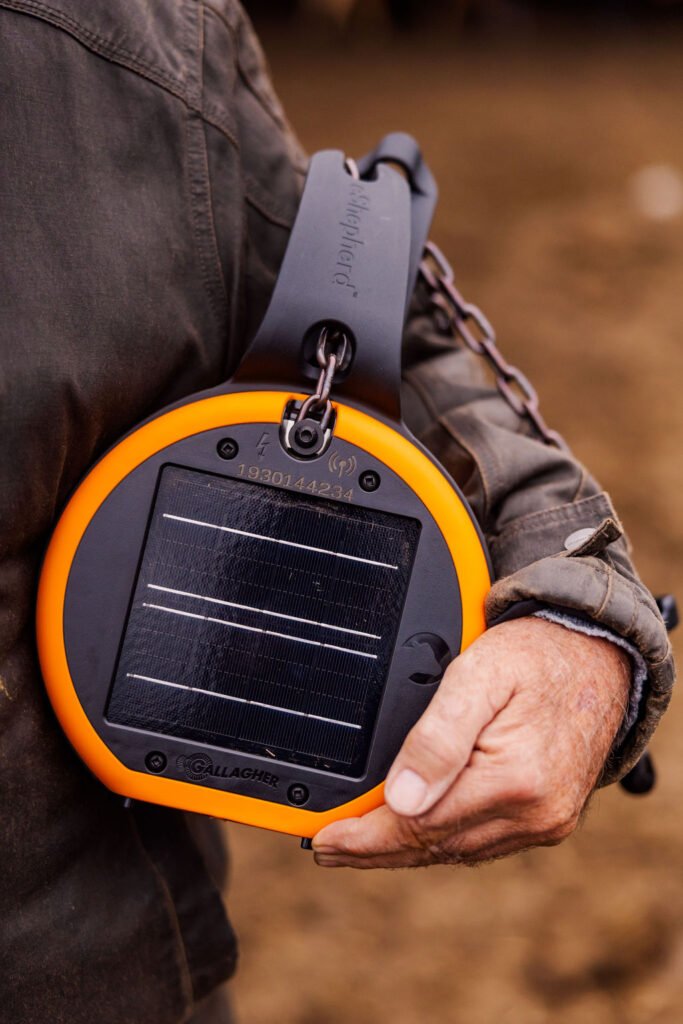
They’re solar charged with a battery designed to last 7 to 10 years.
Get a quote for your herd
Tell us your herd size, where you graze and what coverage you get, and Lee will give you a price with a funding-ready breakdown. Not sure whether you have enough cell coverage to run the system? We can help you figure that out too. Call 250-309-4955 or request a quote below.