

If you have searched for grazing rotation advice online lately, you might be bewildered and confused… articles throw around terms like adaptive multi-paddock grazing, management intensive grazing, time-controlled grazing, and cell grazing as if everyone already knows what those mean and how they differ. It can feel like you need a degree in agronomy just to figure out where to start.
We know where you’re at, and what info you want – we have rodeo and ranching roots, and we have been fencing and consulting across the Okanagan Valley and broader British Columbia and Alberta since 1985. We have worked with operations from the bench lands above Oliver to the grasslands near Kamloops, on private land and Crown leases alike. So let’s cut through the noise and give you a real breakdown of the grazing systems that actually exist, what makes each one distinct, when to use it, and what it looks like on the ground here in BC.
There are seven legitimate grazing rotation systems worth knowing. Here they are.
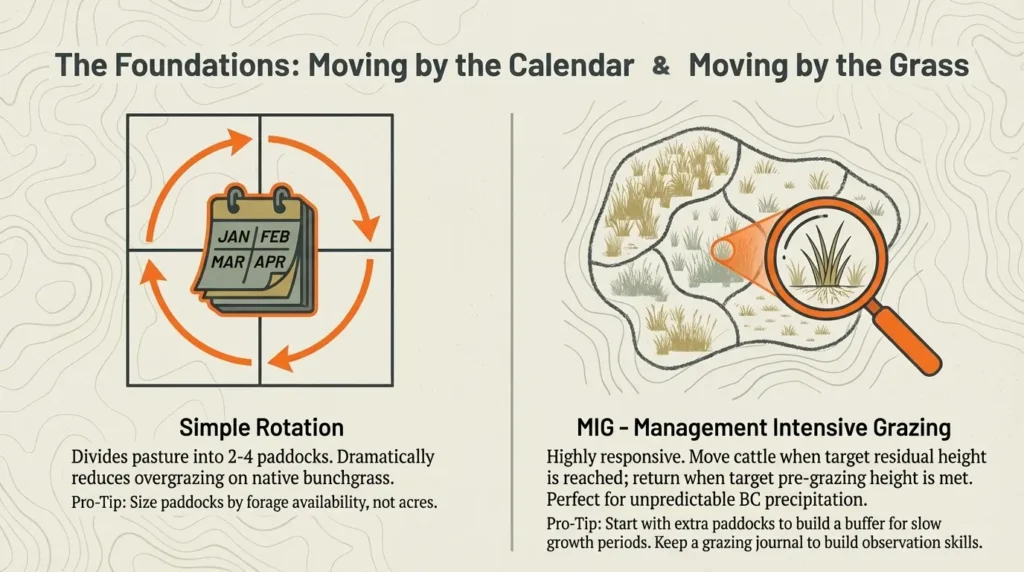
1. Simple Rotational Grazing
This is where most ranchers start, and there is nothing wrong with that. You divide your pasture into two, three, or four paddocks and move your herd through them on a set schedule. Graze one section for a few weeks while the others rest and recover, then rotate.
Whether you are running two paddocks or four, this is fundamentally the same system. More paddocks means longer rest periods between rotations and better forage recovery, but the logic is identical. A two-paddock system might give each section a four-week rest. A four-paddock system stretches that to six weeks. Both are simple rotational grazing.
Why it works in the Okanagan: Our Interior grasslands and native bunchgrass range respond well to this approach as a starting point. Even a basic rotation dramatically reduces overgrazing pressure and starts improving ground cover within a single growing season.
What you need: A reliable perimeter fence and one or more interior divisions. If your perimeter is already solid, getting started can be as simple as one run of temporary electric fencing down the middle of a pasture.
Pro tip: Size paddocks by forage availability, not acres. A rocky hillside section carries fewer animals than an irrigated tame flat. Splitting your land evenly by area is one of the most common setup mistakes we see.
2. Management Intensive Grazing (MIG)
Management Intensive Grazing takes the logic of simple rotation and makes it responsive. Instead of moving cattle on a calendar schedule, you move them when the pasture tells you to. You watch for when the current paddock has been grazed to your target residual height and the next paddock has recovered to a target pre-grazing height, then you move.
In practice, this means visiting your paddocks regularly, learning what “ready to graze” and “ready to move” look like on your specific land, and adjusting your moves accordingly. In a wet spring you might rotate every five days. In a dry July you might stretch to three weeks.
Why it suits BC conditions: Precipitation in British Columbia is unpredictable year to year and within a season. A rigid fixed schedule designed for average conditions will overgraze during dry stretches and underutilize recovery opportunities during wet ones. MIG keeps you in sync with what is actually happening on your land.
The skill it builds: Observation. The ranchers who do this well spend real time walking their land. After a few seasons, your instincts for when a paddock is ready become reliable. Keep a simple grazing journal: date, paddock, forage height, weather notes. That record pays off faster than you would expect.
Pro tip: Start with more paddocks than you think you need. Extra paddocks give you room to respond to slow growth periods without pulling cattle off recovering pasture too early.
3. Strip Grazing
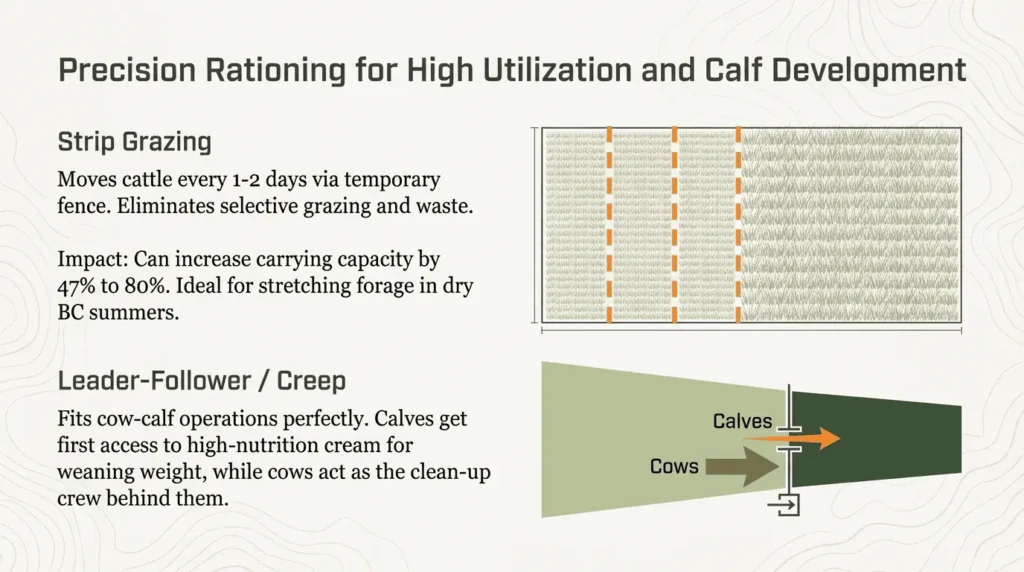
Strip grazing is intensive by design. You give cattle access to a narrow strip of pasture, often just enough for one to two days of grazing, using a movable temporary electric fence or virtual fence such as Gallagher eShepherd. When they have grazed it down, you move the fence forward to the next strip.
The result is very high forage utilization. Cattle in a small area cannot be selective grazers. They eat what is in front of them, including plants they would normally skip. This reduces waste from trampling and refusal, and it means less-palatable species get grazed more evenly, which improves pasture composition over time. Research suggests strip grazing can increase carrying capacity by 47 to 80 percent compared to continuous grazing.
The tradeoff is daily labour. Moving temporary fencing every one to two days requires real commitment. Virtual fencing offers a real benefit in this situation, you can schedule the moves ahead of time using your phone or laptop, which nearly eliminates the labour requirement to implement such a system.
Best use cases in British Columbia:
- Stretching limited forage during a dry summer
- Rationing annual forages like winter rye or turnips
- Managing recovery paddocks precisely
- Smaller operations where daily moves are manageable
Pro tip: Start with wider strips than you think you need. Running out of forage mid-strip is harder to manage than having a little left over. Tighten up as you learn your herd’s daily intake.
4. Leader-Follower and Creep Grazing
This one is particularly relevant for cow-calf operations, which describes a lot of British Columbia ranches.
Leader-follower grazing uses two groups to graze a paddock in sequence. The leaders, your highest-priority animals, go in first and get the best quality, most accessible forage. The followers come in after and graze what remains. Common pairings are milk cows leading with heifers or dry cows following, or in a beef operation, cows leading with stockers or backgrounders following.
Creep grazing is a related approach where calves access a fresh paddock ahead of their mothers through small creep gates. The calves get first crack at the most nutritious, tender growth at the time when they need it most for weaning weight and development. The cows clean up behind them. eShepherd virtual fencing really shines for creep grazing; because the calves are collared, they can move ahead of their moms and access the optimal nutrition, while their moms are held back.
Why it matters for cow-calf producers: Calves and cows have different nutritional needs, especially leading into weaning. Leader-follower and creep systems let you meet both without running separate herds on entirely separate land. You get very high forage utilization and targeted nutrition at the same time.
What it takes: A bit of extra fencing and, for creep grazing, creep gates sized to let calves through but not cows (or eShepherd virtual fencing). If you want some help to think through the infrastructure needs for a creep feeding scenario, we are always happy to give advice.
Pro tip: The quality difference between first-pass and second-pass forage is real but variable. In peak spring growth the gap is smaller. Later in summer, leaders get a noticeably better diet. Time your creep or leader-follower windows around your calves’ most critical growth phases.
5. Cell Grazing
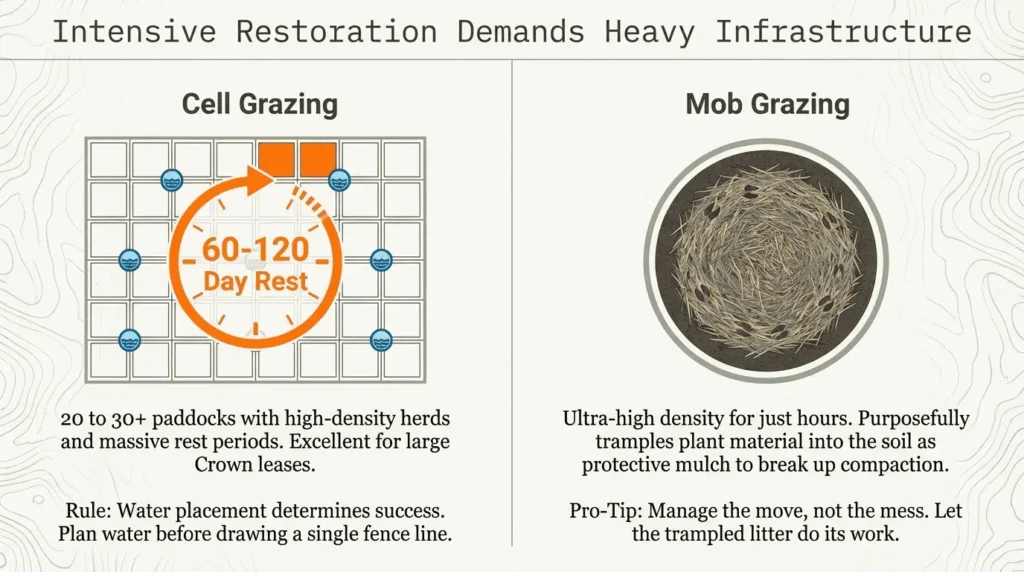
Cell grazing is what MIG looks like when taken to its logical conclusion. You divide your land into many small paddocks, sometimes 20, 30, or more, and run a high-density herd through them on short rotations. Each cell gets a long rest period before cattle return, often 60 to 120 days.
The high animal density in each small cell produces even, thorough grazing across the entire area. Manure and urine are deposited uniformly. Plants are grazed consistently rather than selectively. The long rest periods give even stressed or degraded pasture time to genuinely recover. Roots deepen, soil biology rebuilds, and forage diversity improves over time.
Who this is for: Larger operations with the infrastructure budget and management capacity to work with many paddocks. Cell grazing requires more fencing upfront (or the use of virtual fencing) and reliable water access in each cell. The long-term productivity gains are well-documented, but it is not a system to jump into without proper layout planning.
We are seeing more interest in cell grazing from ranchers on larger Crown leases and from those focused on rangeland restoration after years of continuous grazing. If that describes your situation, let’s talk. Getting the fencing layout right from the start saves significant cost and headache down the road, and that kind of planning conversation is something we are glad to have before any fencing goes in the ground.
Pro tip: Water placement determines whether a cell system runs smoothly or drives you crazy. Plan your water distribution before you plan your paddock layout.
6. Mob Grazing
Mob grazing is the most misunderstood system on this list, partly because it looks wrong at first glance. You stock cattle at extremely high density on a very small area for a very short time, sometimes just hours. Then you move them and give that area a long rest of 60 to 90 days or more.
The herd grazes intensively and tramples a significant portion of the grass into the soil surface as litter. That is intentional. The trampled plant material acts as a protective mulch. It conserves moisture, protects against erosion, and as it decomposes, returns organic matter and nutrients to the soil. Over time, mob-grazed land typically shows improved soil structure, better water infiltration, and stronger plant recovery.
A mob-grazed paddock looks rough after a pass with flattened grass everyehwere. You may find it uncomfortable at first! But the results over multiple seasons are hard to argue with.
When British Columbia ranchers use it: Mob grazing is gaining ground among ranchers focused on range restoration and regenerative practices. It is particularly useful for breaking up compacted soils and kickstarting recovery on degraded range. It is not for every operation, but it is a legitimate, well-researched tool worth understanding.
Pro tip: Manage the move, not the mess. The trampled material is doing work. Resist the urge to tidy up or graze it again before the full rest period is complete.
7. Rest-Rotation and Deferred Rotation
These two systems are less common on intensively managed private land but are widely used on Crown grazing leases and larger range operations across British Columbia and Alberta. If you hold a Crown lease, you have likely already encountered them in your range management plan.
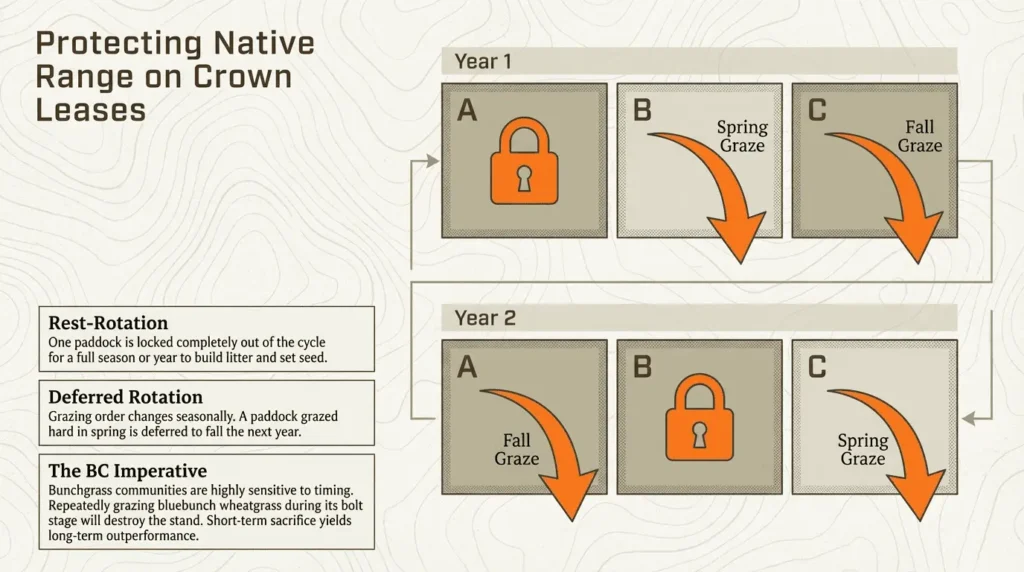
Rest-rotation takes one paddock completely out of the grazing cycle for a full season or a full year, on a rotating basis. In a three-paddock system, for example, a different paddock is fully rested each year while the others are grazed normally. The rested paddock gets to build litter, deepen roots, and sometimes set seed. Over a full rotation of years, every section of your range gets an extended recovery period.
Deferred rotation is different: all paddocks are grazed every year, but the rotation order changes from season to season. A paddock that was grazed first in spring one year might be deferred to fall the next, so it gets a chance to grow and set seed during the period it was previously grazed hard. No section always takes the pressure during its most sensitive growth phase.
Why these matter in BC: Bunchgrass communities that make up a lot of the Interior range are sensitive to the timing of grazing, not just the frequency. Grazing bluebunch wheatgrass during bolt stage year after year weakens stands significantly over time. Rest-rotation and deferred systems give those plant communities the seasonal relief they need to stay productive.
Pro tip: Rest-rotation looks like sacrifice in the short term. One paddock sitting empty for a full season feels like lost production. Ranchers who stick with it consistently report that the rested paddock outperforms in subsequent years, making up the difference and then some.
A Quick Comparison
| System | Complexity | Best For | British Columbia Fit |
| Simple Rotation | Low | Getting started, most operations | Excellent starting point |
| MIG | Medium | Responsive management, variable seasons | Well-suited to Okanagan climate variability |
| Strip Grazing | Medium-High | Forage rationing, high utilization | Dry years, annual forages |
| Cell Grazing | High | Large operations, range restoration | Crown leases, larger ranches |
| Mob Grazing | High | Soil restoration, regenerative focus | Degraded range recovery |
| Leader-Follower / Creep | Medium | Cow-calf operations | Strong fit for Okanagan cow-calf producers |
| Rest-Rotation / Deferred | Medium | Crown leases, native range | Required or recommended on many BC leases |
Where to Start
If you are coming from continuous grazing, do not try to implement cell grazing or mob grazing in year one. Start with a simple two or three-paddock rotation. Get comfortable moving cattle, watch how your pasture responds, and build from there.
If you are already rotating and want to do it better, MIG principles are the most practical next step for most British Columbia and Alberta operations. Learning to read your pasture and move based on forage condition rather than the calendar is the single biggest improvement most ranchers can make.
And if you are managing a Crown lease with native range, rest-rotation and deferred rotation are worth understanding deeply, because the native grasses on range do not respond the same way tame pastures do.
If you have questions about which system fits your operation, or you want to talk through what fencing you would need to implement any of these approaches, get in touch. We are local, we know this land, and we are glad to help. A fencing layout designed around the wrong grazing system is expensive to fix. We would rather help you get it right from the start.
What Infrastructure Do You Actually Need?
Once you have settled on a grazing system, the fencing question becomes practical: what do you actually need to make it work, and what is overkill?
The honest answer for most rotational systems is that you need less permanent infrastructure than you think, and more temporary electric fencing than you probably own right now.
Permanent Perimeter First
Whatever system you run, your perimeter fence needs to be solid. This is not the place to cut corners. A failed perimeter at the wrong moment puts cattle on a neighbour’s crop or a highway, and no rotation schedule survives that kind of disruption. If your perimeter is aging or has problem sections, that is the first thing to address before you invest in any interior fencing.
Temporary Electric Fencing for Everything Inside
For interior divisions, whether you are splitting a pasture into two paddocks or running daily strip moves, temporary electric fencing is the right tool for almost every situation. It is affordable, quick to set up, easy to reconfigure as your system evolves, and effective at managing cattle when it is set up and energized properly.
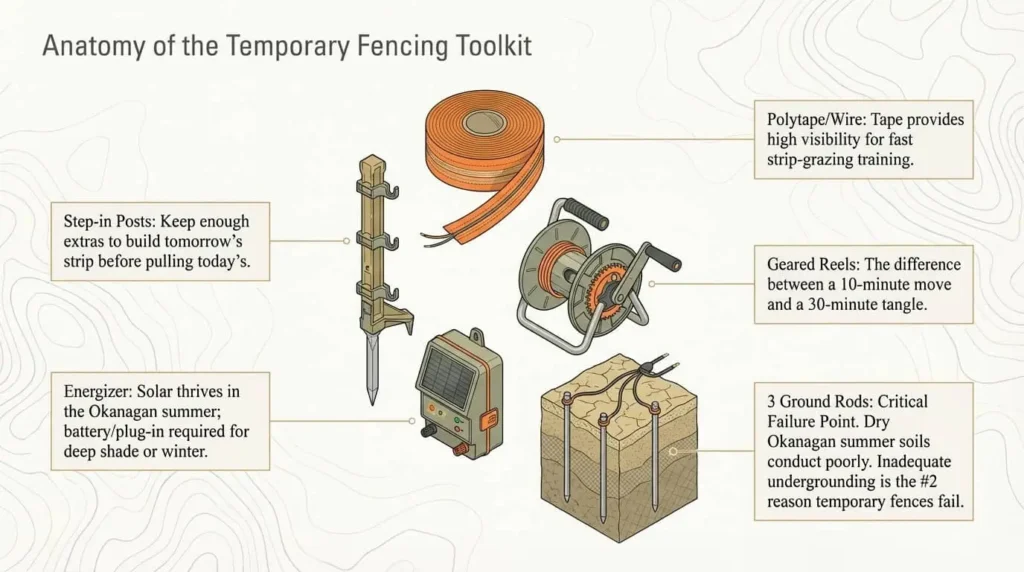
A basic temporary electric fencing kit for rotational grazing includes:
Polywire or polytape: Polywire is durable and low-visibility, good for permanent-ish interior divisions. Polytape is more visible and works well for strip grazing where cattle are encountering a new fence line frequently. Visible fence teaches cattle to respect the wire faster.
Step-in posts: Lightweight, fast to install, and easy to pull and move. For strip grazing you will want enough posts to set up your next strip while cattle are still on the current one, so you are not pulling and resetting the same posts every day.
Reels: A good reel makes strip grazing manageable. Being able to wind and unwind polywire quickly without tangles is the difference between a 10-minute daily move and a frustrating half-hour ordeal. Buy better reels than you think you need.
Energizer: Sized to your fence length and vegetation contact. An underpowered energizer is the most common reason cattle stop respecting a temporary fence. In the Okanagan, solar energizers work well through most of the grazing season. For year-round use or shaded terrain, a battery or plug-in unit is more reliable.
Grounding: Undergrounding is the second most common reason temporary electric fencing underperforms. Dry Okanagan soils in summer can be poor conductors. Three ground rods minimum, properly spaced, makes a significant difference in fence performance during dry stretches.
The Razer Grazer: If you are doing any volume of strip grazing or frequent paddock moves, the Razer Grazer is worth knowing about. It is an all-in-one portable fencing unit that combines your energizer, solar panel, battery, ground rod, and up to three reels of Power Braid reflective rope on a single towable trailer. You hook it to a quad, side-by-side, or truck and drive your new fence line out in a fraction of the time it takes to walk it by hand. The built-in Quik-wind reel system winds and unwinds electrically, so pulling and resetting wire is fast work rather than a half-hour ordeal. Ranchers who move fence daily consistently report saving an hour or more per day over hand reeling. We carry the Razer Grazer and are glad to walk you through the specs and whether it fits your operation.
eShepherd Virtual Fencing
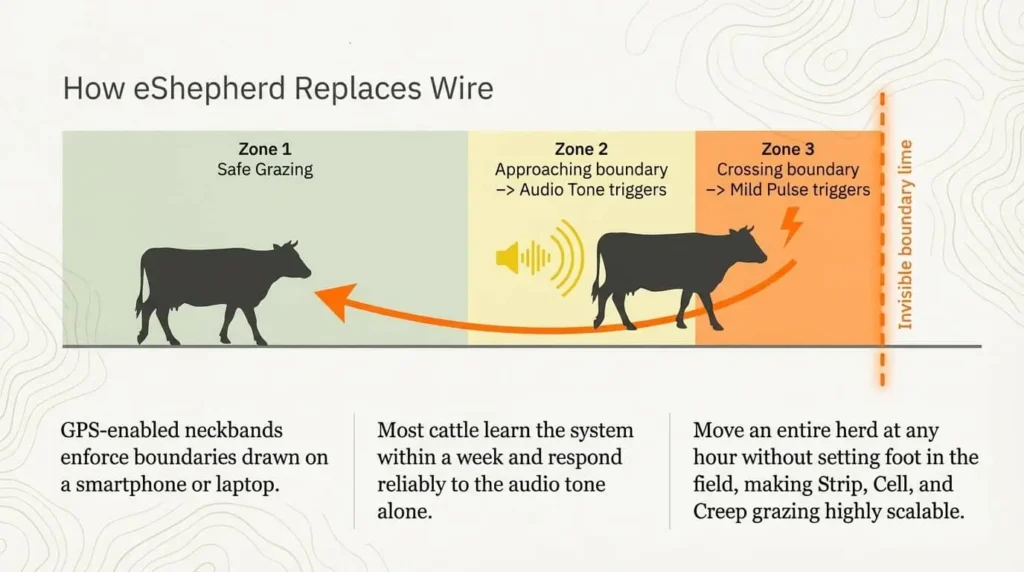
If you want to take rotational grazing to another level without the daily labour of moving physical fences, eShepherd is worth a serious look. We sell eShepherd collars and hardware, and we have seen what the system can do for operations across a range of sizes and terrain types.
Here is how it works. Each animal wears a GPS-enabled neckband collar. You draw your paddock boundaries on a phone, tablet, or computer, and the collars enforce those boundaries using a behavioral cue system: first an audio tone as the animal approaches the boundary, then a mild electrical pulse if it continues. Most cattle learn the system within a week and respond reliably to the audio cue alone. You can move the entire herd to a new paddock from your phone, at any hour, without setting foot in the field.
Why it fits rotational grazing so well: The systems that benefit most from frequent moves, strip grazing, cell grazing, MIG, are also the systems that demand the most labour. eShepherd removes the daily physical work of moving polywire and step-in posts while keeping all the management flexibility. You can run tighter rotations, move cattle more frequently, and manage more paddocks than would be practical with physical temporary fencing alone.
What it works best with: eShepherd is not a replacement for your perimeter fence. The system works best when there is a perimeter fence that keeps the cattle from roadways or other farms. Think of it as replacing your interior fencing, not your boundary. Your perimeter stays physical; everything inside can be virtual.
Connectivity options: eShepherd offers two connectivity options: cellular for quick setup and lower cost, or LoRa base stations for remote terrain with limited coverage. For ranches in the Okanagan Valley with reasonable cell service, cellular is typically straightforward. For more remote terrain or Crown lease land, a LoRa base station setup is the right call. We can help you assess which option suits your property before you invest.
For operations where labour is the limiting factor on how intensively you can manage your grazing, eShepherd changes the equation significantly.
About Okanagan Ranch and Fence Supplies
We are a family-owned ranching and fencing operation based in Armstrong BC in the Okanagan Valley since 1985. While our roots are in British Columbia, we offer our products and expertise all throughout Western Canada. We have a ranching and rodeo background, which means our advice comes from lived experience, not from a product catalogue.
Over the years we have watched a lot of good ranchers struggle with grazing management not because they lacked knowledge, but because they had the wrong infrastructure for the system they were trying to run, or the right infrastructure installed in the wrong layout. That is the gap we try to fill. We sell innovative fencing solutions like eShepherd virtual fencing and the Razer Grazer and we are glad to sit down with you and think through what your specific operation actually needs before anything gets built.
If you have questions about grazing systems, fencing layouts, or any of the products mentioned in this article, send us an email and we will get back to you.
Email: info@okanaganranchandfence.ca
Okanagan Ranch and Fence okanaganranchandfence.ca
Where to Learn More:
The Canadian Grassland and Forage Council has excellent resources for producers – link here: Advanced Grazing Systems – Producers | Canadian Forage & Grassland Association
The Peace River Forage Association of British Columbia has an extensive complication of useful tips and experiences that are invaluable to forage producers, link here: Forage Facts Archive – Peace River Forage Association